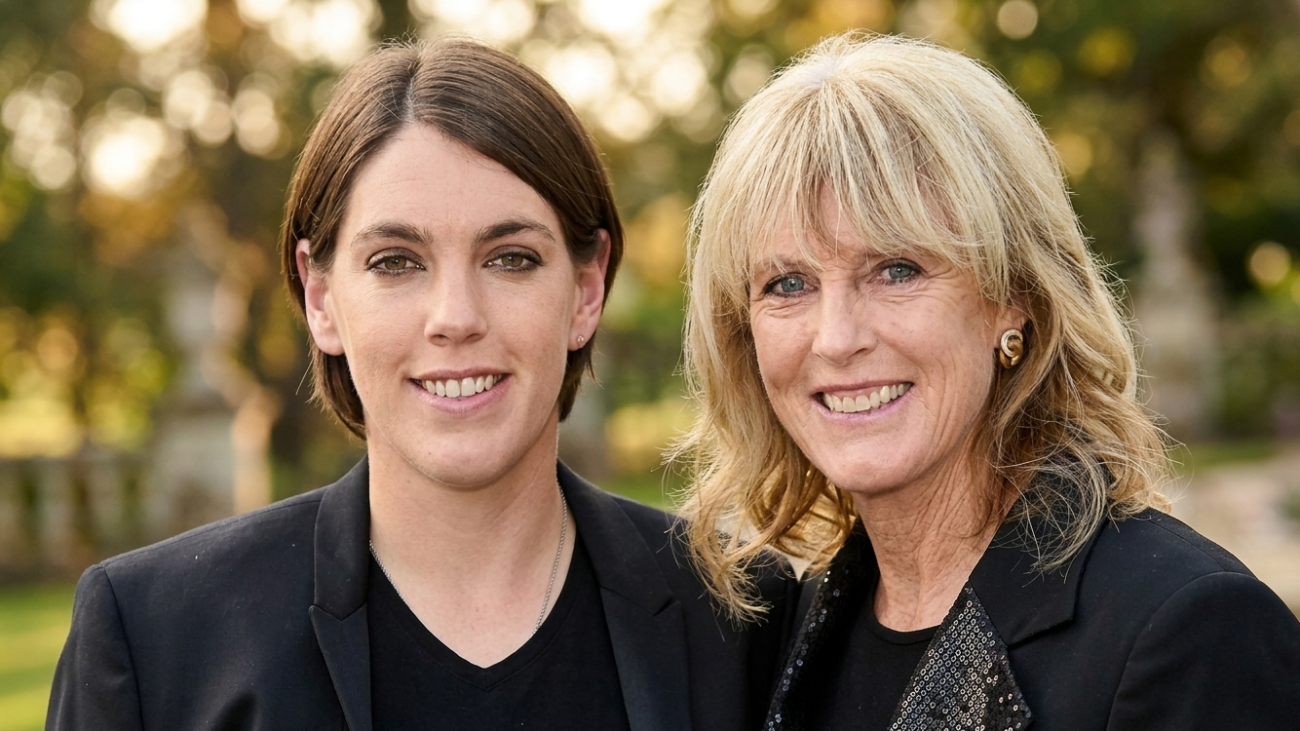
Barbara Boothe remains one of those figures whose early life is deliberately shielded from the public spotlight, and as a result, very little confirmed biographical detail is available about her upbringing, education, or formative years. What can be understood from her later presence in the narrative of American tech and entertainment history is that she came from a background far removed from celebrity culture, and she did not initially pursue public recognition or a career designed for media attention. Her story, at least in public memory, begins not with fame, but with proximity to one of the most transformative technological eras of the modern world.
Rather than being defined by a long list of early achievements or public milestones, Barbara Boothe’s life becomes notable through the relationships and family connections that later placed her near the center of Silicon Valley’s rapid rise. This absence of early public documentation contributes to a certain mystique around her identity, making her less of a conventional public figure and more of a private individual who briefly intersected with high-profile history. In many ways, her life reflects the experiences of many individuals who find themselves adjacent to major historical movements without actively seeking the spotlight.
Meeting Larry Ellison and the Silicon Valley Years
Barbara Boothe’s name becomes historically significant largely through her connection with Larry Ellison, the co-founder of Oracle Corporation, during a period when Silicon Valley was still in a formative and highly experimental stage. At the time, Oracle was not yet the global software giant it would become, but rather a rapidly evolving company navigating the early days of relational database technology and enterprise computing.
Their meeting is often described in general biographical accounts of Ellison’s early personal life as part of the intense and fast-moving social environment surrounding emerging tech companies in the late 1970s and early 1980s. During this era, Silicon Valley was characterized by long working hours, ambitious engineering goals, and a culture that blended technical obsession with entrepreneurial risk-taking. Within that environment, personal relationships often developed quickly and intensely, shaped by the pressure and excitement of building something entirely new.
Barbara Boothe’s presence in this ecosystem placed her in close proximity to one of the most influential technological developments of the late 20th century. While she was not a public-facing figure in the company’s development, her life during this period was intertwined with a moment in history when software infrastructure was being redefined and the foundations of modern digital enterprise systems were being built.
Marriage and Private Life
Barbara Boothe eventually married Larry Ellison in the early 1980s, during a phase when Oracle was still expanding and Ellison himself was transitioning from an ambitious entrepreneur into a widely recognized technology leader. Their marriage occurred before Ellison became a global business icon, which means it took place during a period of relative uncertainty and rapid change rather than established wealth and fame.
The marriage itself lasted only a few years, ending in divorce in the mid-1980s. Although public accounts of their relationship remain limited, it is generally understood that the pressures of building a rapidly scaling technology company, combined with the demands of personal life, contributed to a relationship that could not be sustained long-term. This was not unusual in the early Silicon Valley environment, where intense professional commitments often reshaped personal relationships at a fundamental level.
Despite the eventual separation, this chapter of Barbara Boothe’s life became historically significant not because of the marriage itself, but because of what came from it—most notably, her children, who would go on to become influential figures in the global entertainment industry. Unlike many individuals who remain connected to public figures after separation, she chose a path of privacy and distance from the media, stepping away from the growing public attention surrounding Ellison’s expanding empire.
Motherhood and Raising David and Megan
Perhaps the most enduring and publicly visible part of Barbara Boothe’s legacy is her role as the mother of David Ellison and Megan Ellison, two individuals who would independently shape modern Hollywood through film production and media innovation.
David Ellison, born in 1983, went on to become the founder of Skydance Media, a production company known for major Hollywood films and large-scale entertainment franchises. Megan Ellison, born in 1986, founded Annapurna Pictures, a company recognized for critically acclaimed films and bold creative storytelling choices. Both children entered the entertainment industry not as passive heirs to a legacy, but as active builders of new creative institutions.
Barbara Boothe’s role in their upbringing is often described in general terms rather than detailed public accounts, reflecting her consistent preference for privacy. However, it is widely understood that she provided a stable foundation during their formative years, especially after her separation from Larry Ellison. Raising children connected to one of the most prominent business figures in the world would have inevitably involved unique challenges, including balancing normal upbringing with the realities of wealth, public attention, and inherited expectations.
Despite these complexities, both David and Megan Ellison developed strong independent identities in the entertainment industry. Their achievements suggest a background that valued ambition, creative thinking, and resilience—qualities that are often shaped as much by parental influence as by personal drive. While Barbara Boothe does not appear frequently in media narratives, her indirect influence can be observed through the success and direction of her children’s careers.
Life After Divorce and Commitment to Privacy
Following her divorce from Larry Ellison, Barbara Boothe gradually withdrew from public visibility. Unlike many individuals connected to high-profile business figures, she did not pursue media appearances, public commentary, or involvement in corporate narratives tied to Oracle or Silicon Valley. Instead, she chose a life largely outside of public documentation, focusing on personal matters and family life.
This decision to maintain privacy has played a significant role in shaping how she is perceived today. In an era where personal histories are often extensively documented and shared, her absence from public platforms has created a narrative defined more by silence than by publicity. As a result, much of what is known about her comes indirectly through references to her former marriage and her children’s achievements, rather than from direct statements or public interviews.
Her retreat from public life also reflects a broader pattern seen among individuals who were once connected to rapidly growing industries during their early stages. The explosive expansion of Silicon Valley created many stories where personal lives intersected briefly with technological history before diverging into entirely separate paths. Barbara Boothe’s life after divorce represents one such divergence, where proximity to global influence did not translate into continued public engagement.
Legacy Through Children and Cultural Influence
Although Barbara Boothe herself is not a public entrepreneur, executive, or media figure, her legacy is strongly reflected in the accomplishments of her children. David and Megan Ellison have each built influential companies that have reshaped modern filmmaking, particularly in terms of production scale, creative independence, and the blending of commercial and artistic cinema.
Skydance Media, founded by David Ellison, has been associated with major Hollywood productions, including large-scale action and franchise films that reach global audiences. The company represents a modern model of entertainment production that merges traditional filmmaking with advanced digital production techniques and global distribution strategies.
Annapurna Pictures, founded by Megan Ellison, has taken a different but equally impactful approach, focusing on auteur-driven storytelling, artistic risk-taking, and critically acclaimed films that often prioritize narrative depth and creative expression. Through this company, Megan Ellison has become known for supporting filmmakers who push the boundaries of conventional cinema.
In this sense, Barbara Boothe’s indirect legacy is woven into two distinct but influential strands of modern entertainment. While she is not publicly credited as a contributor to these industries, her role as a parent places her within the foundational story of two major cultural institutions. The influence of upbringing, environment, and early family structure often plays a subtle but meaningful role in shaping individuals who go on to achieve public success.
Public Perception and Media Silence
Barbara Boothe occupies a unique position in public perception: she is widely recognized by name in association with a major tech figure, yet she remains largely absent from detailed media narratives. This combination of recognition and silence creates a rare kind of public identity—one defined more by association than by personal publicity.
Media coverage of her is typically brief and focused on biographical context related to Larry Ellison or her children, rather than on her own independent activities. This has resulted in a limited but consistent curiosity about her life, particularly among those interested in the personal histories behind influential technology and entertainment families.
At the same time, her absence from public discourse can be interpreted as a deliberate and sustained choice. In a world where visibility is often equated with relevance, her life suggests an alternative model—one in which influence can exist indirectly, through family, environment, and private contribution rather than public recognition.
Conclusion
Barbara Boothe’s story is not one defined by public achievements, corporate leadership, or media presence, but rather by her place within a broader historical and cultural framework that connects Silicon Valley’s early growth with the evolution of modern Hollywood. Her life intersects with moments of technological transformation, entrepreneurial expansion, and creative reinvention, yet she herself remains largely outside the spotlight that these developments generated.
What makes her story notable is precisely this contrast: proximity to extraordinary public figures combined with a consistent commitment to privacy. Through her children, her influence extends into contemporary culture in meaningful ways, particularly in the world of film and entertainment. Through her personal choices, she also represents a quieter narrative—one in which not all participants in major historical movements seek or require public visibility.
In the end, Barbara Boothe’s legacy is not written in headlines or public records of achievement, but in the enduring impact of the family she helped shape and the quiet distance she maintained from the fame surrounding her.
