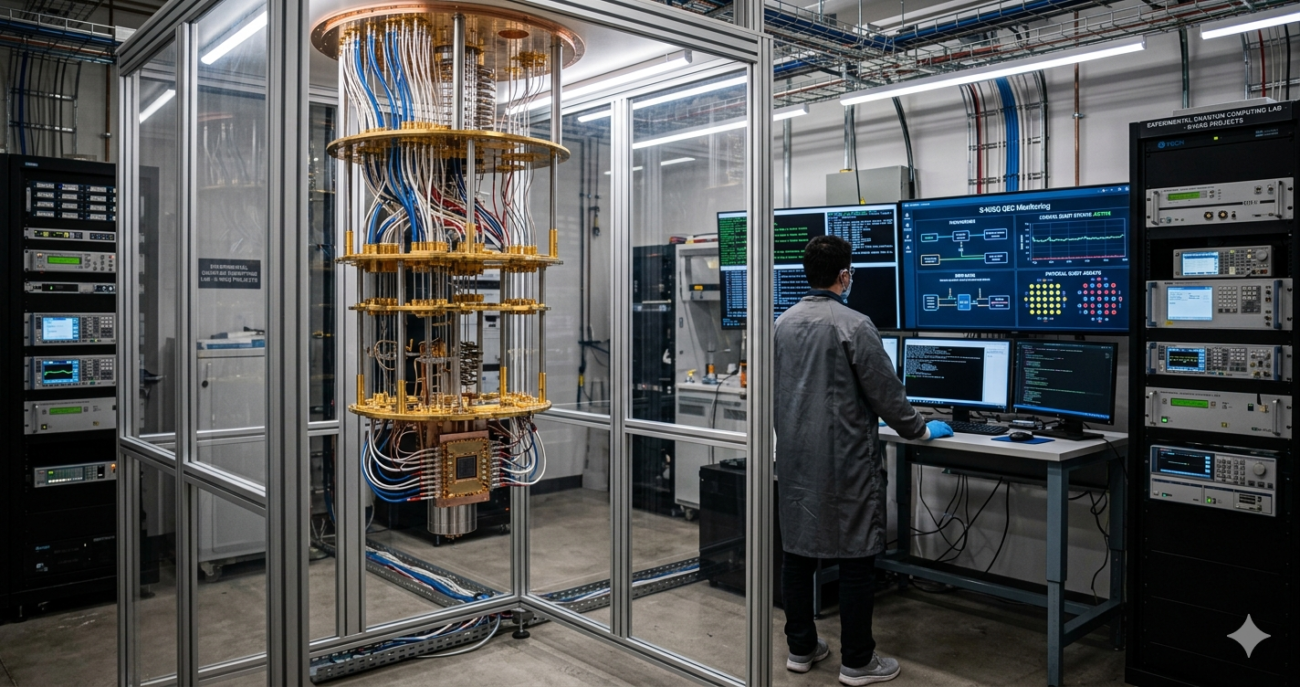
The rise of quantum computing has brought forward an entirely new way of processing information, but it also comes with a persistent challenge: noise. In real-world devices, qubits are extremely sensitive to environmental disturbances, leading to computational errors that can quickly ruin calculations. This is where s-nisq quantum error correction becomes a critical concept. It represents a developing approach designed specifically for the Noisy Intermediate-Scale Quantum (NISQ) era, where fully fault-tolerant quantum computers are not yet available.
At its core, s-nisq quantum error correction focuses on practical methods to stabilize quantum computations without requiring the enormous overhead of traditional error correction schemes. Instead of waiting for perfect quantum hardware, researchers are building techniques that work with the imperfections of current systems. The importance of s-nisq quantum error correction lies in its ability to make quantum computing usable today rather than in some distant future.
As quantum systems continue to grow in size and complexity, s-nisq quantum error correction is becoming the key to unlocking meaningful applications in chemistry, optimization, machine learning, and cryptography. Understanding it requires exploring both the theoretical foundations and the engineering breakthroughs that support it.
s-nisq quantum error correction and the NISQ era challenges
To understand s-nisq quantum error correction, it is essential to first understand the environment in which it operates. The NISQ era is characterized by quantum processors with tens to a few hundred qubits. While impressive, these systems are highly unstable, and quantum decoherence remains a major obstacle.
Traditional quantum error correction methods require thousands of physical qubits to protect a single logical qubit. This is not feasible in current hardware. As a result, s-nisq quantum error correction emerged as a more realistic solution tailored to limited resources. It aims to reduce overhead while still improving reliability.
One of the major goals of s-nisq quantum error correction is to strike a balance between performance and practicality. Instead of fully eliminating errors, it focuses on mitigating them enough to allow useful computation. This shift in mindset is crucial because it acknowledges that noise is not something that can be entirely removed in near-term devices.
Researchers working on s-nisq quantum error correction also explore hybrid systems where classical computation assists quantum error mitigation. This combination enhances performance while keeping resource demands manageable. It reflects a more flexible and adaptive approach compared to traditional rigid frameworks.
Core principles behind s-nisq quantum error correction
The foundation of s-nisq quantum error correction lies in understanding how quantum information degrades. Qubits suffer from bit-flip errors, phase errors, and decoherence due to interactions with their environment. Instead of trying to completely prevent these issues, s-nisq quantum error correction introduces methods to detect and reduce their impact.
One widely used strategy within s-nisq quantum error correction is error mitigation rather than full correction. Techniques such as zero-noise extrapolation and probabilistic error cancellation allow systems to estimate and reduce the effect of noise without requiring large qubit overhead.
Another important aspect of s-nisq quantum error correction is encoding redundancy in more efficient ways. While traditional error correction codes demand heavy resource usage, newer approaches compress protection schemes to fit within limited qubit budgets. This makes s-nisq quantum error correction highly practical for today’s quantum processors.
The adaptability of s-nisq quantum error correction also allows it to evolve with hardware improvements. As qubit quality increases, these methods can scale gradually rather than requiring a complete system redesign. This evolutionary design philosophy is one of its biggest strengths.
Technologies enabling s-nisq quantum error correction
Modern advancements in quantum hardware and software play a major role in making s-nisq quantum error correction possible. Superconducting qubits, trapped ions, and photonic systems each present unique error profiles, and s-nisq quantum error correction adapts to these differences.
Machine learning is also becoming a powerful tool in s-nisq quantum error correction. Neural networks can analyze noise patterns and predict correction strategies dynamically. This allows quantum systems to adjust in real-time, improving computation accuracy without excessive overhead.
Another key technology supporting s-nisq quantum error correction is variational quantum algorithms. These algorithms are naturally resilient to noise and can be optimized even in imperfect environments. By combining them with error mitigation strategies, s-nisq quantum error correction becomes even more effective.
Quantum control systems are also critical. Precise calibration of pulses and gate operations helps reduce the baseline error rate, making s-nisq quantum error correction easier to implement. The synergy between hardware improvements and algorithmic techniques defines the current progress in this field.
Applications of s-nisq quantum error correction in real-world systems
The practical importance of s-nisq quantum error correction becomes clear when examining its applications. In quantum chemistry, for example, accurate simulation of molecules requires highly precise quantum states. Without error mitigation, results quickly become unreliable. s-nisq quantum error correction enables more stable simulations even on imperfect hardware.
In optimization problems, such as logistics and financial modeling, s-nisq quantum error correction helps maintain consistency in outputs. Even small reductions in error rates can significantly improve solution quality in complex search spaces.
Machine learning is another promising area where s-nisq quantum error correction plays a role. Quantum-enhanced models rely on stable computations to train effectively. By reducing noise impact, s-nisq quantum error correction improves learning accuracy and model reliability.
Cryptography and security applications also benefit from s-nisq quantum error correction. Quantum systems designed for encryption and decryption tasks require high fidelity operations, and error mitigation ensures these systems remain trustworthy.
As industries begin experimenting with quantum technology, s-nisq quantum error correction becomes a foundational layer that supports early adoption and experimentation.
Future evolution of s-nisq quantum error correction
Looking ahead, s-nisq quantum error correction is expected to evolve alongside hardware improvements. As qubit coherence times increase and gate fidelities improve, the reliance on heavy error mitigation will gradually decrease. However, s-nisq quantum error correction will still play a vital transitional role.
One future direction involves integrating s-nisq quantum error correction directly into quantum compilers. This would allow error mitigation strategies to be applied automatically during program execution, reducing the need for manual optimization.
Another promising area is adaptive error correction, where systems continuously learn from their own noise patterns. In this model, s-nisq quantum error correction becomes a dynamic and self-improving process rather than a static set of rules.
Researchers also anticipate hybrid quantum-classical architectures where s-nisq quantum error correction is deeply embedded into computation workflows. This will enable more scalable and practical quantum applications across industries.
Ultimately, the future of quantum computing depends heavily on how effectively s-nisq quantum error correction evolves in the coming years.
Conclusion
In summary, s-nisq quantum error correction represents a crucial step forward in making quantum computing practical in the near term. Rather than waiting for perfect hardware, it embraces the reality of noisy systems and provides intelligent ways to work within those limitations.
From improving simulations to enhancing machine learning and optimization tasks, s-nisq quantum error correction is already shaping how quantum algorithms are designed and executed. Its flexible, adaptive nature ensures that it remains relevant as technology continues to advance.
As the field progresses, s-nisq quantum error correction will likely remain a cornerstone of quantum development, bridging the gap between experimental devices and fully fault-tolerant quantum machines. The journey of quantum computing is still unfolding, and s-nisq quantum error correction stands at the center of that transformation.
